


Too Wonderful for Me

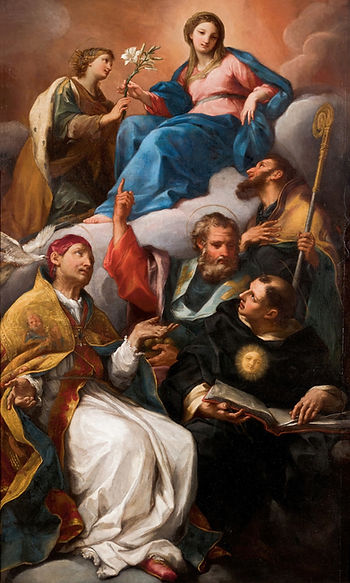
Greetings on this feast of the Immaculate Conception! We are pleased to announce that the second volume of our Augustine Opera Omnia, On the Trinity, is now available for pre-order.
If the Confessions reveals Augustine's restless heart finding its rest in God, De Trinitate reveals his restless mind reaching toward the very Mystery in whom he rests. This is Augustine at the height of his theological powers, wrestling with the most profound truth the Church proclaims: that the one God is Father, Son, and Holy Spirit.
"Your knowledge is too wonderful for me; it is mighty and I cannot attain it. (Ps 139:6). From myself indeed I understand how wonderful and incomprehensible is your knowledge with which you have made me, seeing that I am not even able to comprehend myself whom you have made; and yet a fire burns up in my meditation (Ps 39:3), causing me to seek your face always." (Book XV, Chapter 2)
Augustine sets out, with the confidence of faith, to understand as far as possible what he loves and believes. In the first seven books, he searches the Scriptures of both Testaments for the revelation of the Trinity, then turns to philosophy to defend the orthodox faith against the Arians. In the final eight books, he embarks on an interior journey, discovering in the human mind—the image of God—an analogy of the divine Trinity that opens out into a program of spiritual renewal for every serious Christian.
Fr. Edmund Hill, O.P. has given the English-speaking world what many consider the finest translation of this work, capturing both Augustine's rigor and his warmth. We are honored to present his translation, edited by John E. Rotelle, O.S.A., in this beautiful new bilingual edition.
As we release this volume, we are also delighted to unveil our new Augustine Opera Omnia timeline page, where you can follow the progress of the entire Augustine project. From the Confessions to the City of God, from the Psalms commentaries to the letters and sermons, we have mapped out the years ahead.
The Immaculate Conception is a fitting day for such an announcement. Mary, full of grace, was overshadowed by the Holy Spirit, bore the eternal Son, and was beloved of the Father. In her, the Trinitarian mystery took flesh. Augustine would have delighted in the connection.


I appreciate how reflective writing can encourage people to think more deeply about life and faith. After reading thoughtful pieces like this, I enjoy Bitlife which is a life simulation game where choices shape each journey.
Dit artikel behandelt het thema op een evenwichtige en goed gedocumenteerde manier. Ik waardeerde de consistentie van toon door de hele tekst heen. Ik heb dit artikel al gedeeld met enkele collega's die zich met hetzelfde onderwerp bezighouden. Het is een evenwichtig artikel dat het onderwerp op een complete manier behandelt.